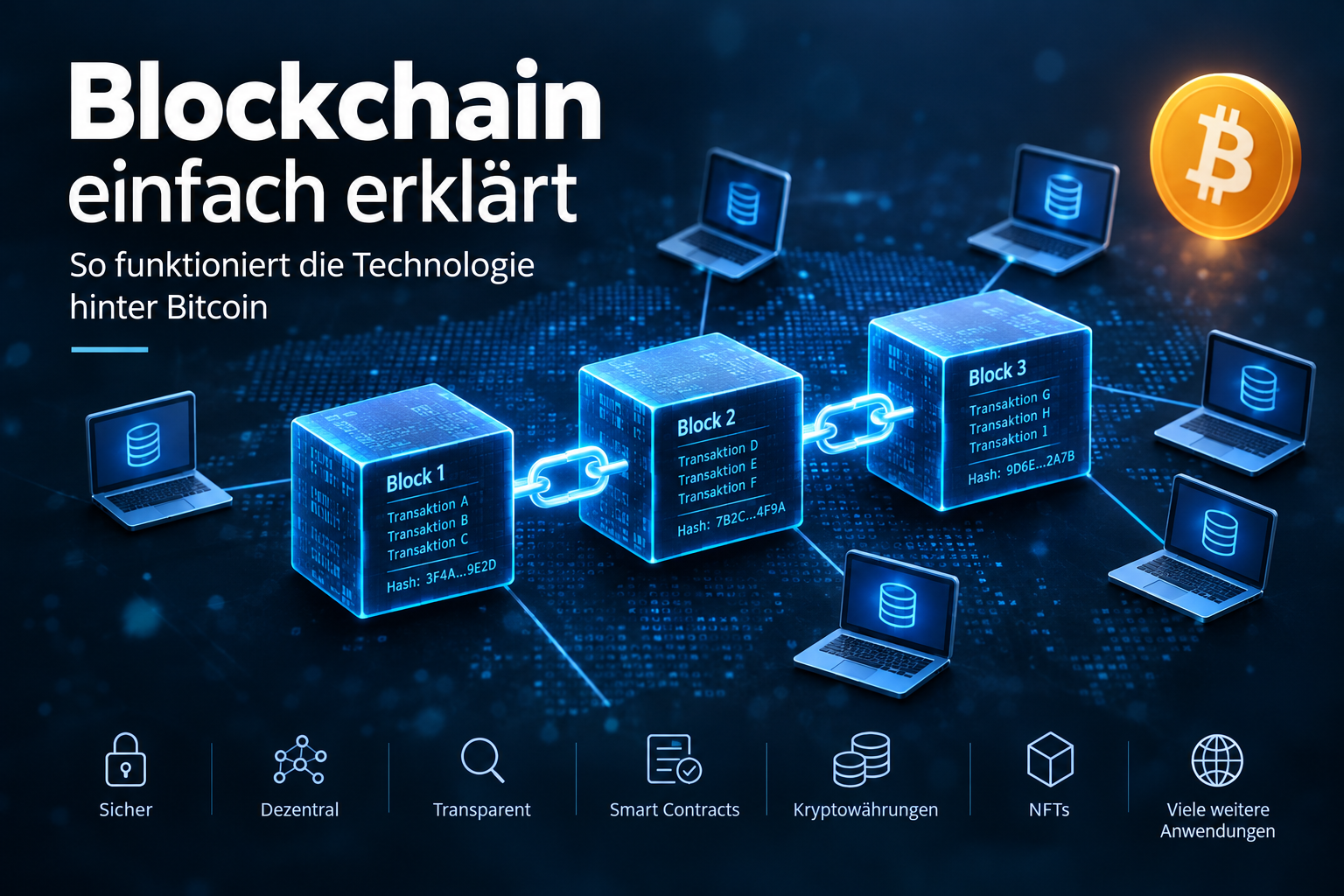
Blockchain is one of the best-known technologies of recent years. Many people are familiar with it primarily through Bitcoin and other cryptocurrencies. However, the technology can also be used in many other areas.
The technology is designed to store data and transactions securely, transparently, and tamper-proof. It does so without the need for a central authority to control all the information.
But how does a blockchain actually work? And where is it used?
What Is Blockchain?
A blockchain is a digital database in which information is stored in interconnected blocks. It is often managed collectively by multiple computers rather than being stored exclusively on a central server. The technology is best known for its use in Bitcoin and other cryptocurrencies.
How can you visualize a blockchain?
You can think of a blockchain, at first, as a digital ledger.
Information is stored in this ledger. For example, it might record that one person has transferred a certain amount to another person.
The key difference from a regular ledger is that a blockchain can be organized so that many computers participate in the network together. These computers verify transactions and adhere to common rules.
The term “blockchain” is composed of two English words:
- Block = a package of data
- Chain = chain
The data is stored in blocks that are cryptographically linked to one another. This creates a digital chain. As a result, subsequent changes to data that has already been confirmed are detectable and, depending on the blockchain, possible only with considerable effort.
How does blockchain work?
To understand what blockchain means, it’s worth taking a look at how this technology works and its connection to Bitcoin.
The principle is relatively easy to explain.
Imagine you want to send money to another person using a cryptocurrency.
First, the transaction is transmitted to the blockchain network. Other computers in the network verify whether the transaction is valid.
For example, they check whether the transaction was created correctly and whether the necessary digital authorizations are in place.
If everything checks out, the transaction can be stored along with other transactions in a new block.
This block is then appended to the existing blockchain.
This gradually creates a long chain of many blocks.
Why is blockchain considered secure?
One important reason is cryptography.
It uses mathematical methods to protect data and make any changes detectable.
Each block contains information linked to the previous block. This connects the individual blocks to one another.
If someone were to try to secretly alter older information, the connection to the rest of the blockchain would no longer match.
On large public blockchains, such manipulation is therefore very difficult.
However, this does not mean that a blockchain is fundamentally impossible to alter. Security depends, among other things, on the specific blockchain, its size, and its technical architecture.
Blockchain and Bitcoin—What’s the Difference?
Bitcoin and blockchain are often equated with one another. But that is not correct.
Bitcoin is a cryptocurrency. Blockchain is the technology on which Bitcoin is based.
Bitcoin uses a blockchain to store transactions and make them traceable.
Other cryptocurrencies also use blockchain technology. These include, for example, Ethereum and numerous other projects.
However, blockchain can also be used for applications that have nothing to do with cryptocurrencies at all.
In my review of the Bitaxe Gamma 601, I’ll show you how Bitcoin mining works at home.
What are smart contracts?
Another important term related to blockchain is “smart contract.”
Simply put, it’s a program that can be executed on a blockchain.
A smart contract can automatically execute predefined rules.
Here’s a simple example:
A person pays a certain amount. As soon as the payment is received, a digital service is automatically activated.
This does not necessarily require an employee to manually verify the transaction.
Smart contracts can therefore be useful when processes need to run automatically and transparently.
Where is blockchain used?
Blockchain is currently being used or tested in various fields.
Cryptocurrencies
The best-known area of application is cryptocurrencies. Bitcoin and Ethereum are arguably the best-known examples.
Finance
Banks and financial institutions are also exploring blockchain.
Among other things, this involves faster transactions, digital assets, and so-called tokens.
Supply Chains
Blockchain can also be of interest in supply chains.
For example, companies can use it to store information about a product’s journey. This could make it easier to trace where a product comes from and the stages it has gone through.
Digital Identities
Blockchain could also play a role in digital identities.
This involves digitally managing certain forms of proof and sharing them in a controlled manner.
Digital Property Rights
Digital items can also be uniquely identified using blockchain technology.
A well-known example is so-called NFTs.
What are NFTs?
NFT stands for Non-Fungible Token.
Simply put, an NFT is a unique digital token stored on a blockchain.
NFTs first gained prominence a few years ago, primarily through digital art.
However, it’s important to note one key point: Owning an NFT does not automatically mean that you also own all rights to an image, video, or other content.
In this case, the blockchain primarily records the ownership of the respective token.
What are the advantages of blockchain?
What are the advantages of blockchain?
Blockchain technology offers several advantages, particularly when data needs to be stored in a traceable manner and managed collaboratively. However, the specific advantages depend on the particular blockchain.
Traceability: On public blockchains, many transactions can be viewed transparently. This allows interested parties to verify certain transactions themselves.
Protection against tampering: Data that has already been confirmed is protected against undetected changes by the cryptographic linking of blocks and the network’s rules. Depending on the blockchain, making changes can be more or less complex, but it is not fundamentally impossible.
Decentralization: In decentralized blockchains, multiple independent participants can jointly operate the network. This reduces dependence on a single central authority.
Automation: So-called smart contracts can automatically execute predefined conditions. This enables, for example, automated processes for digital transactions.
Transparency: In public blockchains, certain transactions and data can be visible to many participants. This creates opportunities for oversight, but does not automatically mean that the identities of the individuals involved are known.
The combination of these characteristics makes blockchain an attractive option for certain applications. However, whether the technology offers advantages over a conventional database depends on the specific use case.
What are the disadvantages?
What are the disadvantages of blockchain?
Despite its advantages, blockchain technology also has disadvantages. Depending on the system, speed, costs, energy consumption, and usability can play a role.
Limited transaction speed: Some blockchains can only process a limited number of transactions per second. This can lead to delays during periods of high traffic.
Fluctuating transaction costs: Fees depend, among other things, on the specific blockchain and its load. When demand is high, transactions can become significantly more expensive.
Energy consumption: Some blockchain systems use the Proof of Work mechanism. In this process, computers compete using computing power for the right to add new blocks. This can consume a lot of electricity. Other systems use mechanisms such as Proof of Stake, which generally require significantly less energy.
Complex operation: For beginners, using a blockchain may feel unfamiliar at first. Anyone who manages cryptocurrencies on their own must, in particular, store their private keys securely.
Risk of Lost Access Credentials: If private keys are lost and there is no suitable backup, access to the associated cryptocurrencies may be permanently lost.
These drawbacks show that blockchain is not automatically the best solution for every application. Whether the technology is worthwhile depends on which requirements need to be met and what alternatives are available.
Do we really need blockchain?
That is an important question.
Blockchain isn’t automatically better than a standard database.
For example, if a company wants to manage its own customer database, a traditional database is usually perfectly sufficient.
Blockchain becomes particularly interesting when multiple independent parties need to jointly manage data and no single entity is supposed to have complete control.
This is precisely where one of the technology’s greatest strengths lies.
What does the future of blockchain look like?
It’s still too early to say exactly how important blockchain will be in the future.
The technology has garnered a great deal of attention, yet technical and practical challenges remain.
New blockchain systems are therefore striving to become faster, more cost-effective, and more energy-efficient.
Companies and financial institutions are also increasingly engaging with digital assets and so-called tokenized products.
It is therefore quite possible that blockchain will be less visible in the future but will play a role behind the scenes in many digital applications.
Frequently Asked Questions About Blockchain
What is a blockchain, explained simply?
A blockchain is a digital database in which information is stored in interconnected blocks. Depending on the system, it is jointly managed by multiple participants.
What is blockchain used for?
Blockchain is used, among other things, for cryptocurrencies like Bitcoin, digital certificates, and certain automated processes involving smart contracts. Whether it’s useful depends on the specific use case.
Is a blockchain secure?
Cryptographic methods and shared network rules can protect stored data from undetected changes. Nevertheless, not all blockchain applications are automatically secure. Software bugs, stolen login credentials, and fraud attempts remain potential risks.
Is blockchain the same thing as Bitcoin?
No. Bitcoin is a cryptocurrency that uses blockchain technology. Blockchain is the underlying technology that can also be used for other applications.
Conclusion: Blockchain Is More Than Just Bitcoin
Blockchain is significantly more than just the technology behind Bitcoin.
The basic principle is actually simple: data is stored in blocks and linked together. A network of computers ensures that the rules are followed.
This allows information to be stored transparently and traceably without necessarily requiring a central authority to control everything.
Whether it’s cryptocurrencies, smart contracts, digital assets, or supply chains—the potential applications are diverse.
Nevertheless, blockchain is not a solution for every problem. Speed, costs, energy consumption, and user-friendliness remain significant challenges.
One thing is certain, however: Blockchain is among the technologies that could have permanently transformed the digital world.
Leave a Reply